A Broken Premolar, a Bone Graft, and a New Implant: A Kharghar Case Study
A tooth that snaps off at the gum line is more than a chipped-tooth problem — often the root left behind can't be saved, and whatever bone was holding it can be affected too. This is a real case from Reform Dental Clinic in Sector 15, Kharghar: a patient came in with a fractured upper right first premolar and a retained root underneath. Here's what it actually took to fix it, step by step, with the clinical photos from the procedure. (A heads-up: a few of the images below are from the surgery itself and show the treated site directly.)
The Problem: A Fractured Premolar and a Retained Root
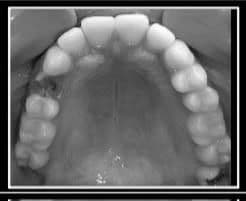
The tooth had broken down at the gum line, leaving a root piece rather than something that could be saved with a filling or a crown. The photo below is from the first visit, showing the upper arch and the site that needed attention.
Step 1: Removing the Retained Root
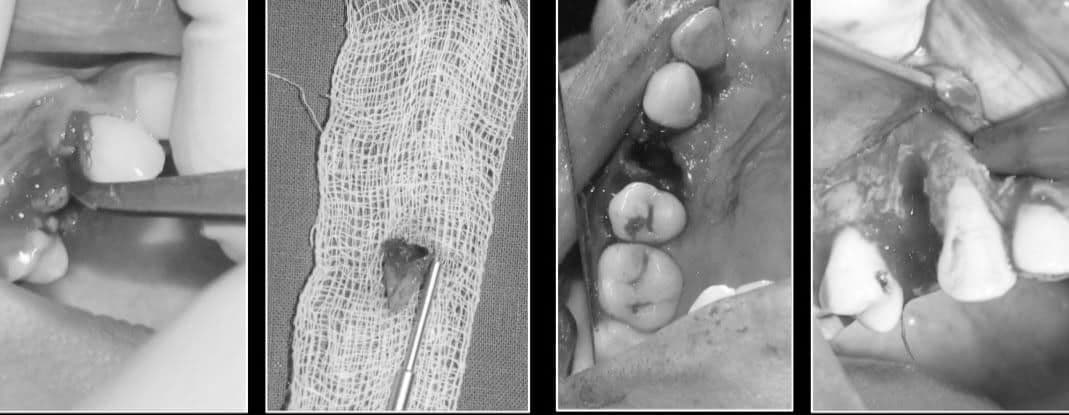
Once a tooth has fractured down to the root like this, the piece left behind usually can't be restored — it has to come out before anything else can be planned. After the root was removed, the buccal bone (the outer wall of bone on the cheek side, which normally cushions and surrounds the root) was found to be thin and exposed. This is a common finding when a tooth has been fractured or infected for a while before it's treated, and it changes the plan: an implant can't simply go straight into a site like this, because there isn't enough surrounding bone yet to hold it securely for the long term.
Step 2: Rebuilding the Bone Before Placing the Implant
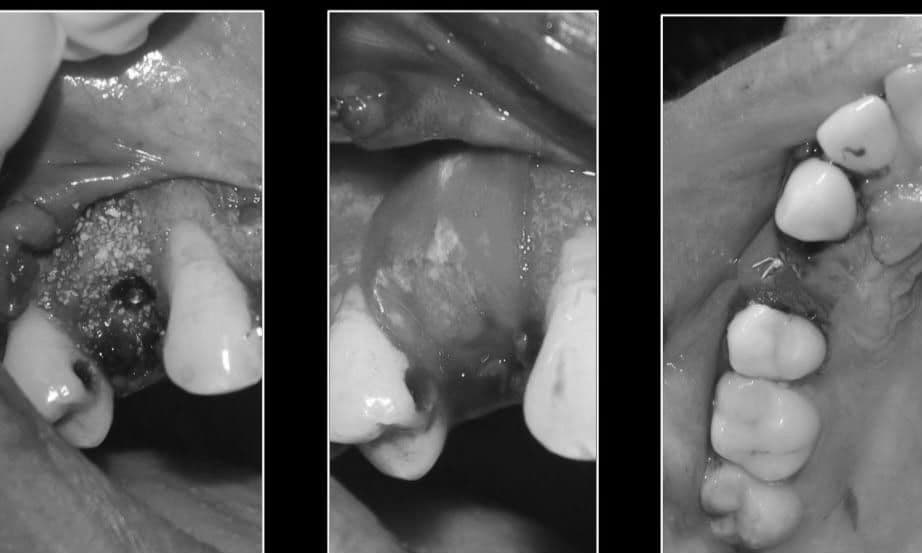
Because the buccal bone was thin, the site needed to be rebuilt before — and alongside — the implant, using a bone graft and a GBR (guided bone regeneration) membrane. The graft material gives the body a scaffold to rebuild bone around the implant, and the membrane holds it in place while that happens. This isn't an unusual extra step; it's a well-established part of implant planning whenever the bone around a site isn't fully intact, which we cover in more general terms in dental implant candidacy in Kharghar: bone grafts and sinus lifts explained. The site was then closed with sutures to heal.
Step 3: Healing, Checked on X-ray
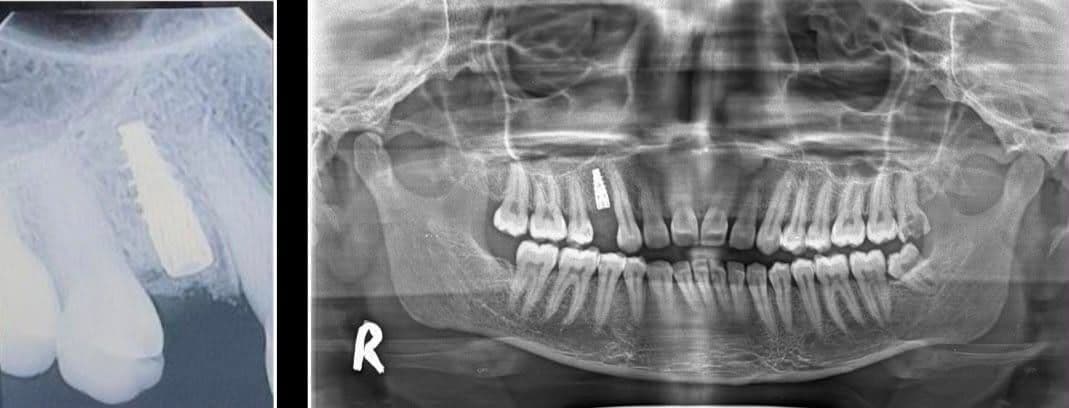
Once the site had healed, follow-up X-rays — a close-up periapical view and a full panoramic (OPG) X-ray — were taken to confirm the implant's position and that it had settled in well. This is a standard check before moving on to the final restoration; it's how the position is confirmed rather than assumed.
Step 4: The Final Result at Four Months
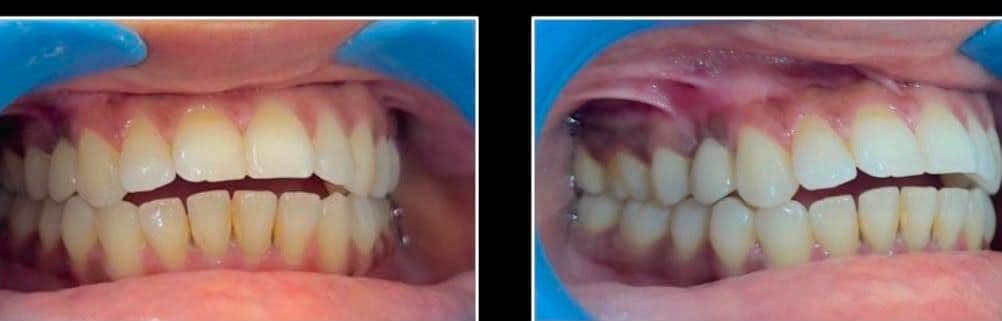
The patient came back for review after four months of healing, and the final crown was placed on the implant. The photos below show the site before treatment began and after the final crown was fitted.
What This Case Shows
A fractured tooth with bone loss underneath isn't a dead end — a bone graft and GBR membrane are routine tools for rebuilding a site like this before, or alongside, implant placement. That said, every case is planned individually after an exam and scan, and healing time and results vary from person to person depending on how much bone needed to rebuild and how the individual heals. If you're curious how a standard implant (without bone loss) is planned and placed, dental implant procedure Kharghar: what actually happens walks through that. If you're comparing an implant against a bridge for a single missing tooth, single tooth implant vs bridge in Kharghar covers both sides.
If you have a broken tooth or a retained root and aren't sure what your options are, message Reform Dental Clinic on WhatsApp and Dr. Shipra Mandwar will assess it honestly, bone grafting included if it's needed. You'll find us at Shop No. 10, Tricity Eros, Behind D Mart, Sector 15, Kharghar, Panvel, Maharashtra 410210, open Monday to Saturday, 10am to 9pm.
Frequently Asked Questions
Can a tooth still be saved if it breaks off at the gum line?
It depends on how much healthy tooth structure is left. If only a root piece remains below the gum line, it usually can't be restored with a filling or crown and needs to be removed — as in this case — before planning a replacement like an implant.
What happens if the bone around a tooth is damaged when it's removed?
If the surrounding bone — particularly the thin outer buccal wall — is found to be thin or missing after extraction, a bone graft and often a GBR membrane are used to rebuild it before or alongside implant placement, giving the implant a stable foundation.
What is a GBR membrane, and why is it used with a bone graft?
A GBR (guided bone regeneration) membrane is a barrier placed over bone graft material to hold it in position and keep soft tissue from growing into the graft site while new bone forms underneath. The two are usually used together.
How long does it take to get the final crown after an implant is placed?
In this case, the final crown was placed four months after surgery. Timelines vary depending on how much bone needed to heal and rebuild, so your dentist will confirm an expected timeline for your specific case.
Is losing bone around a fractured or extracted tooth common?
It's a fairly common finding when a tooth has been fractured, infected, or left untreated for some time before removal. It doesn't rule out an implant — a bone graft is a standard, well-established way to rebuild the site first.
Where can I get a broken tooth or retained root assessed near Sector 15, Kharghar?
Reform Dental Clinic is at Shop No. 10, Tricity Eros, Behind D Mart, Sector 15, Kharghar, Panvel 410210. Dr. Shipra Mandwar will assess the site, including whether a bone graft is needed, and explain the plan honestly. Message us on WhatsApp to book.
Ready to transform your smile?
Book an appointment at Reform Dental Clinic, Sector 15 Kharghar.